


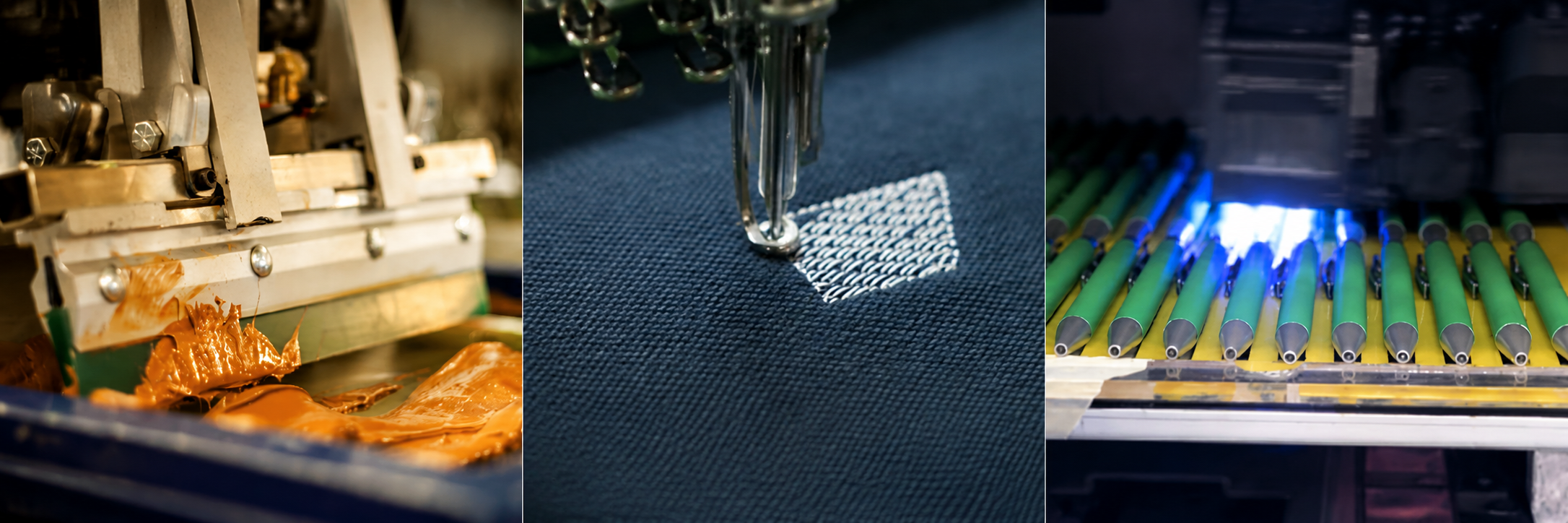
The most common question we receive at Branderpromo isn’t “which T-shirt should I choose?”, but “which decoration technique should I use?”. The short answer: it depends on the material, the number of colours in the logo and the shape of the item. Below is a quick guide to help you choose.
Embroidery is applied to textiles — T-shirts, hoodies, jackets and caps — and can reproduce logos using up to 15 different thread colours, so it is not limited to a single-colour symbol. It withstands repeated washing very well, making it the ideal choice for workwear and uniforms worn every day. This technique is also used to create embroidered patches — the logo is stitched onto a separate piece of fabric, which is then attached to a garment, backpack or cap.
It is not suitable for designs featuring fine colour gradients, as embroidery threads have visible limitations.
The design is printed onto a special film and then transferred onto the textile using pressure and heat. It is a highly versatile technique that works on almost any type of fabric — cotton, polyester and blended materials — making it suitable for both small orders and logos featuring multiple colours or gradients.
Screen printing works best on flat, smooth surfaces — textiles, paper and plastic bags — but it can also be used on cylindrical items such as promotional mugs and bottles. Up to 8 colours can be used. It is not ideal for photographic images or fine colour gradients, although a colour-separation technique can simulate a result close to full colour.
Pad printing is used on small items made from plastic, metal, glass, wood, leather or ceramic — not on textiles. It is ideal for logos up to 7 cm in size, with a maximum of 4 colours and no gradients. It is a fast and cost-effective technique, but it has clear limitations regarding print size and number of colours. One useful detail: prints applied to personalised mugs using pad printing are not dishwasher-safe.
The ink cures instantly under ultraviolet light, providing excellent adhesion and vivid colours. It can be applied to a wider range of surfaces than you might expect — plastic, metal, glass, wood and even textiles — while offering excellent colour quality and high durability.
Sublimation works only on polyester or polyester-coated materials, not on cotton. Special inks are transferred directly into the fibres of the material at a high temperature. It is the ideal technique for detailed, full-colour images on sports T-shirts, textile equipment or rigid polyester-coated items.
How do you choose quickly?
If you are unsure, send us your logo, the product material and the required quantity — and we will tell you exactly which decoration technique is most suitable.
Frequently Asked Questions
Which technique is the most durable for textiles worn every day?
Embroidery. It withstands repeated washing better than other techniques, although it has some limitations when reproducing designs with fine colour gradients.
Can screen printing be used on products other than T-shirts?
Yes — it can be used on flat surfaces such as paper and bags, as well as on cylindrical items such as mugs and bottles, not only on textiles.
Can pad printing be used on T-shirts?
No. Pad printing is only suitable for items with rigid or semi-rigid surfaces, including plastic, metal, glass, wood, ceramic and leather. It cannot be used on textiles.
Explore the Stanley/Stella T-shirt and hoodie collection at Branderpromo and request a quote featuring the right decoration technique for your order.